


Selank 20mg Peptides
Selank is supplied as a lyophilized peptide in a single-vial format containing a material quantity of 20mg. Classified within neuropeptides, this material is provided for controlled laboratory and analytical investigation focused on precise peptide characterization. The single-unit presentation supports consistent handling across repeatable workflows and study designs.
In appropriately equipped facilities, Selank may be applied to receptor-signaling and pathway research, peptide characterization, stability observations, and other non-clinical experimental models. The defined 20mg material quantity supports standardized laboratory methods that prioritize traceable material accounting and reproducibility across replicates and timepoints.
The lyophilized presentation supports accurate weighing and controlled transfers, aiding consistent documentation and batch-to-batch comparison in research settings. No attributes beyond those specified below are claimed.
- Ingredient: Selank
- Material quantity per vial: 20mg
- Total package quantity: 20mg
- Format: Lyophilized peptide vial
- Units per package: 1
- Category: Neuropeptides
- Most orders ship within 24 hours and arrive within 3 to 5 days of leaving our warehouse.
- Shipping is free on orders of $99+ (except Hawaii and Alaska).
- All orders ship in discreet packaging via USPS Ground Advantage mail.
Delivery restrictions vary by state.

This Product Contains

Research Applications
Our catalog supports controlled laboratory research across areas such as:
- Cellular Signaling — receptor activity, signaling pathways, and molecular interactions
- Metabolic Research — metabolic regulation and incretin receptor-signaling models
- Neurobiology — cognitive, behavioral, and stress-response pathways
- Immunology — immune signaling and host-response models
- Tissue Biology — extracellular-matrix signaling, cellular migration, and tissue remodeling research
- Mitochondrial Biology — cellular energy systems and aging-related pathways
- Endocrine Research — neuroendocrine and reproductive-axis signaling
- Pigment Biology — melanogenesis and related cellular pathways
Research relevance varies by compound and study design. Review the product information and batch-specific documentation before use. All products are intended strictly for laboratory research and are not for human or animal use, therapeutic use, or clinical application.
Research Materials Backed by Clear Documentation
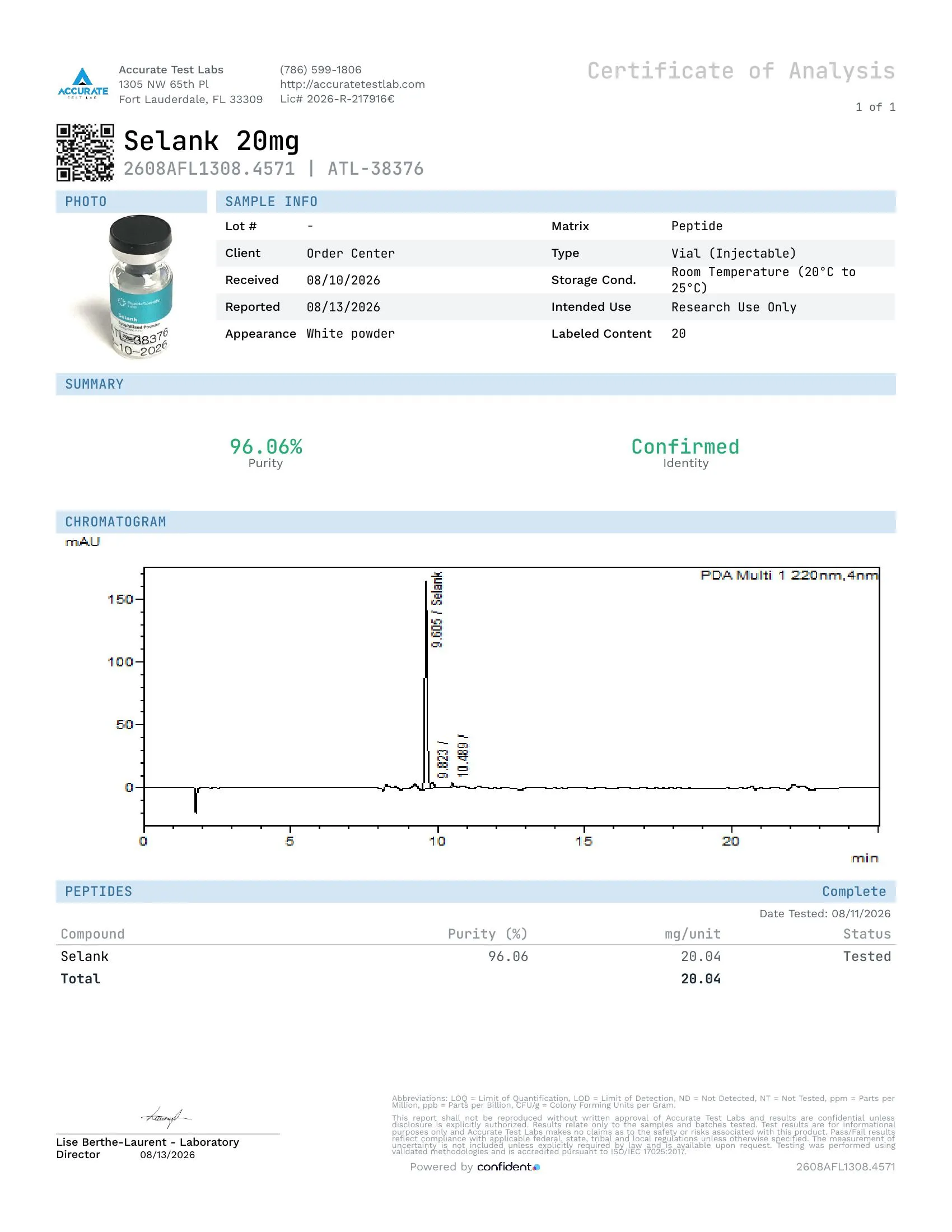
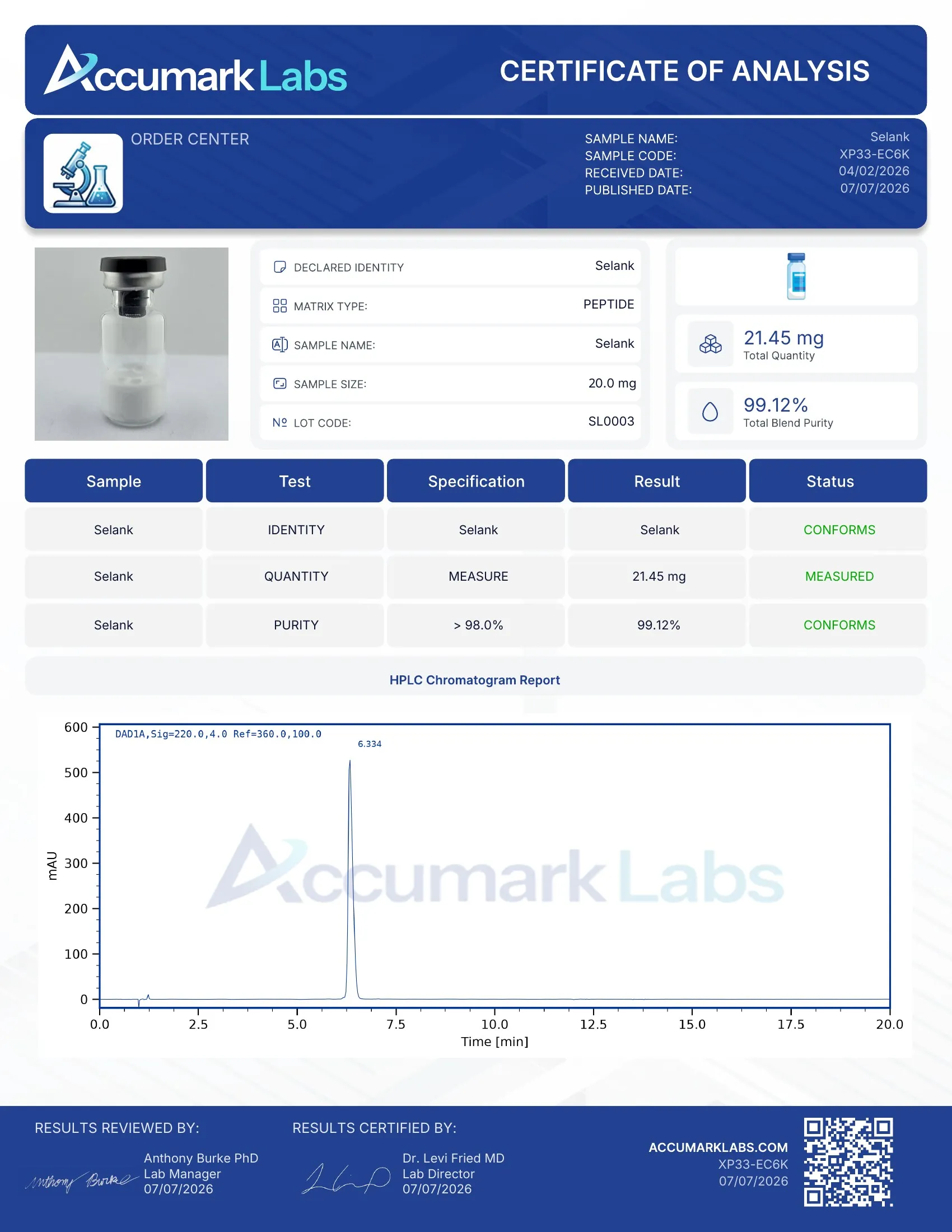
- 99%+ Analytical Purity Where Confirmed by the Applicable Batch COA.
- Third-Party Testing Performed by an ISO/IEC 17025-Accredited Laboratory, Where Applicable.
- Batch-Specific Certificates of Analysis Available for Applicable Research Materials.
- Ships from the U.S.
Orders are dispatched from our U.S. fulfillment center, typically within 1–2 business days. - Clear Product Specifications
Strength, format, quantity, and available batch documentation are presented for review. - Research-First Standards
Our catalog and documentation are built for laboratory research—not consumer, wellness, or therapeutic use.
Storage & Handling
- Product-Specific Storage
This product is supplied as a freeze-dried material. Keep the original container sealed and follow the storage condition shown on the product label or available documentation.
Follow the format-specific instruction shown above. Product-specific label or documentation requirements take priority over the general handling guidance below. - Keep the Original Container Sealed
Until the material is needed for laboratory work, keep it in its original sealed container. Protect it from moisture, unnecessary light exposure, and avoidable temperature fluctuations. - Inspect the Package on Receipt
Check the container, seal, and packaging for visible damage, condensation, or signs of a temperature excursion. Record any issue before placing the material into laboratory storage. - Document Laboratory Handling
Record the material name, batch information, receipt date, storage location, and relevant handling conditions according to your laboratory’s procedures. - After Opening or Preparation
Once the original sealed state changes, follow the product documentation and your laboratory’s validated protocol. Clearly label any prepared material with the preparation date, composition, and applicable storage condition. - Avoid Unnecessary Temperature Cycling
Minimize repeated warming and cooling. Avoid repeated freeze-thaw cycles when frozen storage is required by the applicable protocol. - Use Material-Specific Conditions
Storage requirements can differ between lyophilized, liquid, and prepared materials. Do not apply one temperature, solvent, or stability period to every product.
Reliable U.S. Order Fulfillment
- Order Processing
In-stock orders are generally processed within 1–2 business days, Monday through Friday. Orders are not processed or shipped on weekends. - Standard Delivery
Domestic delivery typically takes 3–5 business days, depending on the destination and carrier. - Shipment Tracking
Tracking information is provided after the order ships so delivery progress can be monitored. - Careful, Discreet Packaging
Each order is packed with care to help protect the contents and maintain privacy during transit. - Nationwide U.S. Shipping
Orders can be shipped within the United States where permitted by applicable federal and state law. - Possible Delays
Carrier conditions, weather, holidays, backorders, and periods of high order volume may affect processing or delivery times.
Why Researchers Choose Well Elevation
Not all peptide vendors hold themselves to the same verification standards.
| VERIFICATION STANDARD | Well Elevation | GENERIC VENDORS |
|---|---|---|
| Purity Standard | Batch-Specific Analytical Purity — See Applicable COA | Often Not Disclosed |
| Third-Party Testing | Independent Laboratory | Testing Source Often Unclear |
| COA Published | Batch-Specific COA Available | Inconsistent Availability |
| Batch Traceability | Product, Strength & Lot Matched | Batch Match Often Unclear |
| U.S. Fulfillment | Ships Domestically | Often Ships From Overseas |
| Research Use Standard | Clearly Defined | Standards May Vary |
Frequently Asked Questions
Find answers to common questions about this product, its research context, Certificates of Analysis (COAs), ordering, and laboratory use.
Selank is a synthetic peptide analog derived from tuftsin-related research. It is mainly discussed in neurobehavioral and neuroimmune literature rather than in skeletal-muscle, metabolic, or extracellular-matrix categories. It is a research peptide of interest in stress and CNS-related models.
Researchers usually study Selank in relation to stress-response behavior in models, neuroimmune signaling and cognitive-emotional regulation. Supplied for laboratory research use only.
Neuropeptides are short chains of amino acids produced primarily by neurons and used as signaling molecules within the nervous system. Unlike classical neurotransmitters, which are small molecules stored in synaptic vesicles, neuropeptides are synthesized as larger precursor proteins and then enzymatically processed into their active short-chain form before being released.
Examples of widely studied neuropeptides include oxytocin, vasopressin, substance P, and neuropeptide Y. They are investigated in connection with mood, stress response, memory, pain signaling, social behavior, and a wide range of other neurobiological processes in research models.
Classical neurotransmitters such as glutamate, GABA, dopamine, and acetylcholine are small, non-peptide molecules. They are typically synthesized directly in the presynaptic terminal, stored in small clear vesicles, and released for fast point-to-point signaling across the synaptic cleft. Their action is usually short-lived and terminated by reuptake or rapid enzymatic breakdown.
Neuropeptides, by contrast, are larger, are produced from longer precursor proteins in the cell body, and are stored in dense-core vesicles. They are generally released under higher-frequency stimulation and tend to produce slower, longer-lasting, and more modulatory effects — often operating over larger spatial distances within the nervous system.
Neuropeptides are produced primarily in neurons of the central and peripheral nervous system, but they are also found in many non-neuronal tissues. Major sites of production include the hypothalamus, pituitary gland, gut enteric nervous system, adrenal medulla, and various endocrine cells throughout the gastrointestinal tract.
This broad distribution is one reason neuropeptides are such a large research area — many of them act at the intersection of nervous, endocrine, and immune signaling. Well Elevation supplies synthetic neuropeptide reference compounds for in vitro laboratory use only.